
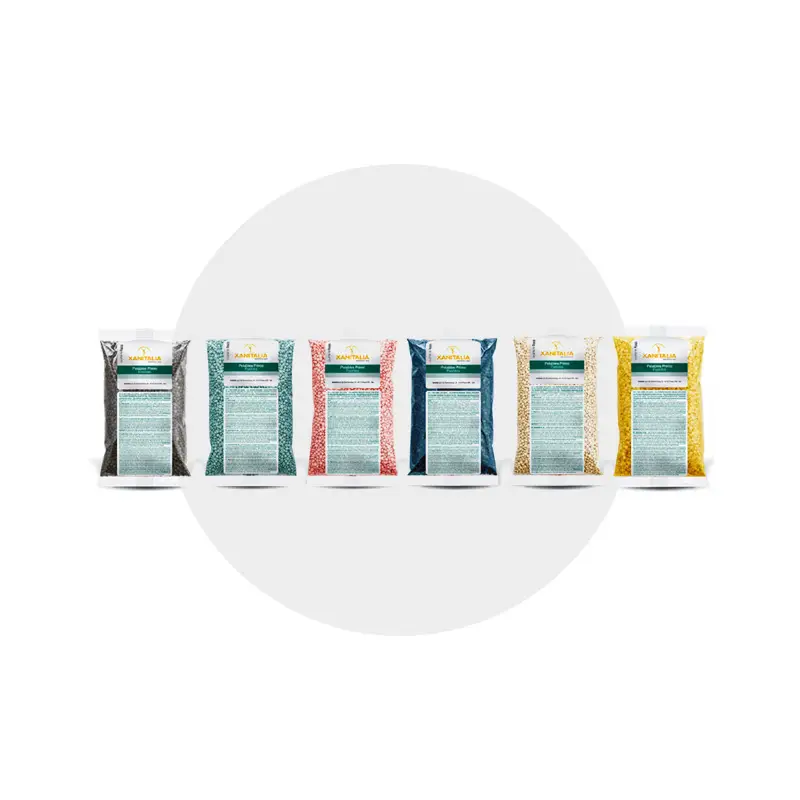
Hard wax beads, also called wax pebbles, melt into a flexible wax that sets on the skin and is removed without a strip. They are widely used for the face, underarms and bikini area because a well-formulated hard wax generally adheres less strongly to the skin than strip wax while gripping the hair.
Comfort and results still depend on the formula, temperature, skin condition and technique. Follow the instructions supplied with your wax and heater whenever they differ from general guidance.
Hard wax versus strip wax
- Hard wax: useful for smaller, curved and sensitive areas. It sets before removal and does not require a strip.
- Strip wax: applied very thinly and removed with a non-woven strip. It is efficient for larger areas such as arms, backs and legs.
For a detailed comparison by treatment area, read our hard wax versus soft wax guide.
Choose the right beads
Select a professional formula intended for the area and hair type you plan to treat. Low-temperature, flexible film wax can be easier to control on delicate areas, while stronger elastic formulas may suit coarse hair. Product names and ingredients alone do not guarantee suitability for sensitive skin, so patch testing remains important.
The Waxpot stocks Xanitalia wax pebbles in several variants. Check each product’s instructions rather than assuming every colour or formula melts and performs identically.
What you need
- A temperature-controlled wax heater
- Hard wax beads or pebbles
- Clean, single-use wooden spatulas
- Pre-wax cleanser or gel
- Post-wax soothing lotion
- Clean cotton pads and suitable protective covering
How to use hard wax beads
1. Check the skin
Do not wax broken, sunburnt, inflamed or recently exfoliated skin. Prescription retinoids and some medical treatments can make skin more fragile; seek appropriate professional advice before waxing.
2. Melt the wax gradually
Add the required amount of beads to the heater and follow the manufacturer’s temperature guidance. Stir carefully until the wax is evenly melted. Avoid turning the heater to maximum simply to speed up the process.
3. Test the temperature
Test a small amount on the inner wrist. The wax should feel comfortably warm, never hot. Recheck during a long treatment because conditions and heater settings can change.
4. Clean and dry the area
Use pre-wax cleanser to remove oil, perspiration and product residue. Allow the skin to dry completely before application.
5. Apply an even layer
Apply in the direction of hair growth, pressing the wax through the hair. Hard wax should be substantial enough to lift in one flexible piece, but not unnecessarily bulky. Leave a slightly thicker lip at the end for removal and work in manageable sections.
6. Allow it to set
Wait until the surface is no longer tacky but the wax still has some flexibility. Exact timing varies with formula, thickness and room temperature.
7. Remove correctly
Hold the skin taut. Lift the edge and remove the wax quickly against the direction of growth, keeping the movement low and parallel to the skin rather than pulling upwards.
8. Soothe the skin
Apply a gentle post-wax lotion. Avoid heat, friction, strong fragrance, direct sun and strenuous exercise for 24 to 48 hours. Introduce exfoliating or ingrown-hair products only after the skin has settled and according to their directions.
Hard wax troubleshooting
- Wax is runny: it may be too hot. Lower the setting and allow it to thicken.
- Wax cracks or breaks: the layer may be too thin, left too long or unsuitable for the room temperature. Adjust one factor at a time.
- Wax stays tacky: it may be too warm, applied too thickly or need more setting time.
- Hair remains behind: the hair may be too short, the skin may not have been dry, or the wax may not have been pressed firmly through the hair.
- Skin lifts or blisters: stop immediately, cool the area appropriately and seek professional medical advice.
Best wax by treatment area
- Face: a facial or low-temperature hard wax in very small sections
- Underarms: flexible hard wax applied according to changing growth directions
- Bikini area: elastic hard wax for coarse hair; professional help is recommended for first-time intimate waxing
- Arms and legs: hard wax can be used, although strip wax is usually faster and more economical on large areas
Shop hard wax beads and equipment
Browse The Waxpot’s professional wax range for Xanitalia wax pebbles, heaters, spatulas and pre- and post-wax care. If facial hair is your main concern, continue with our guide to waxing facial hair at home.